
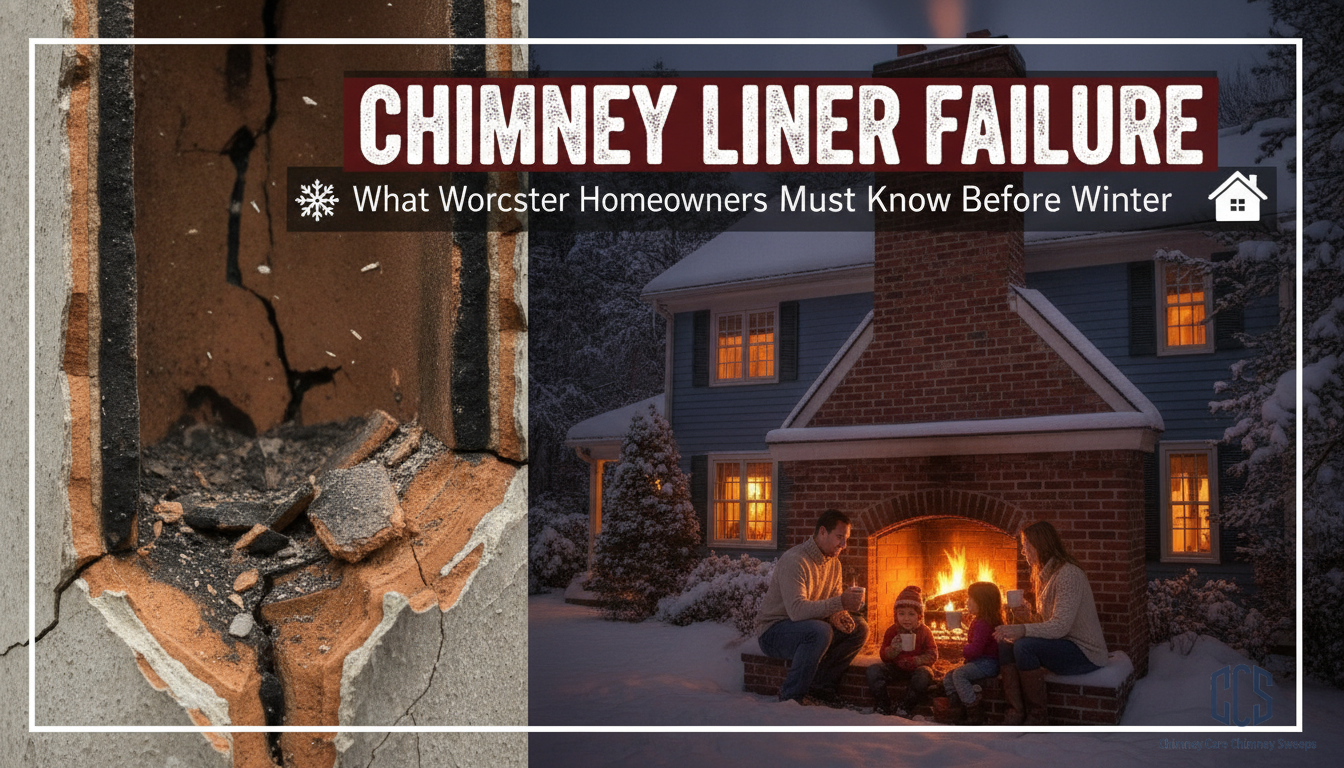
Your Chimney Liner Is the Most Important Safety Component You've Never Seen
Most Worcester homeowners can point to their fireplace, identify their damper handle, and describe their chimney cap. But ask them about their flue liner, and you'll often get a blank look. That's understandable — the liner lives hidden inside the chimney, invisible during normal use. But it is, without question, the single most critical safety component in your entire fireplace system, and when it fails, the consequences can be severe.
The chimney liner serves three essential functions. First, it contains the products of combustion — smoke, carbon monoxide, and heat — and channels them safely out of the home. Second, it protects the surrounding masonry structure from the intense heat generated during combustion. Third, it provides a correctly sized, smooth passageway that promotes proper draft, ensuring gases flow up and out rather than backdrafting into your living space. Remove or compromise any one of these functions, and your fireplace becomes a hazard rather than a comfort.
Why Liners Fail: The Most Common Causes in Worcester Homes
Worcester's housing stock spans centuries. The city's historic triple-deckers, Victorian-era single-families, and mid-century colonials were built when masonry construction was the dominant method and when heating appliances operated very differently than they do today. Many of these homes have original clay tile flue liners that are now 50, 80, or even 100 years old. Even newer construction is not immune — liner damage can develop within years of installation depending on usage patterns and maintenance history.
The most common causes of chimney liner failure in the Worcester area include:
- Age and thermal cycling: Clay tile liners expand and contract with every fire. Over decades, this repeated thermal stress cracks mortar joints between tiles and eventually fractures the tiles themselves.
- Chimney fires: Even a brief chimney fire — often unnoticed by the homeowner — can generate temperatures exceeding 2,000°F that crack or shatter tile liners throughout the flue length.
- Freeze-thaw damage: Water that enters a cracked liner through a damaged crown or missing cap freezes in the mortar joints between tiles, expanding and widening cracks with each cycle.
- Appliance mismatch: When a high-efficiency furnace or boiler replaces an older unit, the newer appliance produces cooler exhaust gases that condense inside an oversized liner, creating acidic condensate that corrodes tile and mortar rapidly.
- Lack of maintenance: Creosote accumulation in an unswept flue traps moisture, creates acidic compounds, and accelerates liner deterioration from the inside out.
The Carbon Monoxide Risk You Can't Afford to Ignore
A cracked chimney liner allows combustion gases — including odorless, colorless carbon monoxide — to seep through the masonry and into living spaces. CO poisoning is responsible for hundreds of deaths in the United States each year, and many victims never knew their chimney liner had failed. CO detectors are essential, but they are the last line of defense. A sound, intact liner is the first.
Heat transfer through a cracked liner is equally dangerous. The structural wood framing surrounding older masonry chimneys is often closer to the flue than modern codes allow. When liner cracks permit heat to radiate directly into that framing, ignition can occur — not during the fire itself, but hours later when the household is asleep and the chimney is still warm. This delayed ignition pattern is precisely why chimney fires are so often described as "starting in the middle of the night."
How We Diagnose Liner Damage: The Level 2 Video Inspection
Unlike a standard visual check, a Level 2 chimney inspection uses a flexible video camera inserted into the flue to examine the entire liner interior from the firebox to the chimney top. The camera reveals hairline cracks, missing mortar joints between tiles, offset tile sections, collapsed tiles, and areas of heavy creosote that may be masking structural damage underneath. Our technician reviews the footage with you in real time and provides a written report with photographs documenting every finding.
A Level 2 video inspection is required by NFPA 211 any time a property changes hands, a new appliance is connected to an existing flue, or there is any reason to suspect liner damage. It is also strongly recommended after any suspected chimney fire — even a small one — and after any severe storm that may have displaced chimney components. Our chimney inspection service covers all three NFPA-defined inspection levels for every situation.
Your Liner Repair Options: Stainless Steel vs. Cast-in-Place
When liner damage is confirmed, Chimney Care Chimney Sweeps offers two proven repair solutions matched to the extent of damage and the type of appliance you're using.
Flexible stainless steel liner systems are the most common solution for Worcester-area homes. We install UL-listed, correctly sized stainless liner — 304 grade for wood and gas applications, 316Ti for oil-burning appliances — routed from the appliance connector through the full height of the chimney and terminated with a proper rain cap. Stainless liners are wrapped in insulation to maintain flue gas temperatures and improve draft. Manufacturer warranties typically run 15 to 25 years, and the liner can last considerably longer with annual maintenance.
Cast-in-place liner systems are the preferred solution when the existing tile liner is severely deteriorated, when the chimney has significant structural irregularities, or when a homeowner wants a seamless, fully insulated flue that maximizes thermal performance. Our technicians pour a specialized insulating mix around a form that is drawn up through the chimney, creating a smooth, monolithic liner that bonds to the surrounding masonry and meets current building codes. Cast-in-place liners are particularly well-suited to older masonry chimneys with offset flues or irregular cross-sections where flexible liner installation is challenging.
All liner installations begin with a thorough Level 2 video inspection to confirm sizing, identify obstructions, and document pre-existing conditions. After installation, we recommend our chimney cap installation service to protect the new liner from rain and wildlife intrusion, and our annual chimney sweeping service to keep the liner clean and the manufacturer warranty valid.
Do Not Use Your Fireplace With a Damaged Liner
This point deserves plain, direct language: if a chimney inspector, home inspector, or our technicians have flagged your liner as cracked, missing, or compromised, do not light a fire until the liner has been repaired or replaced and reinspected. The risk of carbon monoxide intrusion and structural fire ignition during normal fireplace operation with a damaged liner is real and documented. We offer prompt scheduling to minimize the time your fireplace is out of service.
Serving Worcester and Surrounding Communities
Chimney Care Chimney Sweeps provides chimney liner installation and repair throughout Worcester and the surrounding area. Homeowners in Westborough, Northborough, Marlborough, and Shrewsbury trust us for the same Level 2 inspections and precision liner installations we deliver every day right here in Worcester. We serve residential and commercial properties seven days a week
Confirm Availability
Call +17742385550 or fill out our online form for a free, no-obligation quote.
Request Free Quote